
For many in the Sri Lankan diaspora, buying property back home is not
only a major emotional milestone, but also a strategic financial investment.
Whether you are looking for a luxury city apartment in Colombo or a long-term
rental income asset, the desire to buy property in Sri Lanka from overseas
has grown significantly over the last few years. But the experience of handling
a real estate transaction from thousands of miles away often presents valid
concerns related to financial safety, legal compliance, and the accountability
of the developer.
Foreign exchange regulations, cross-border banking and remote due diligence can
be daunting to navigate. Luckily, the purchasing process is no longer the same
thanks to modern financial instruments and legal structures. Through Inward
Investment Accounts (IIA), structured escrow arrangements and stringent due
diligence Sri Lankan expatriates have the opportunity to purchase real estate
remotely with total confidence and assurance.
Can I Purchase Property in Sri Lanka from Abroad?
So yes, basically. The National legislation permits Sri Lankan citizens
residing abroad, foreign nationals of Sri Lankan origin, dual citizens and
non-resident foreign nationals to purchase property in Sri Lanka.
However, the legal framework depends on your citizenship status and the kind of
property you are planning to buy:
- Sri Lanka Citizens & Dual Citizens: You are allowed 100% ownership of land and residential units in all areas of
Sri Lanka.
- Foreign Nationals & Non-Citizens: Foreign nationals are not allowed to purchase land on a freehold basis under the Land (Restrictions on Alienation) Act, but they are able to acquire private land on long-term leases of up to 99 years. Importantly, foreign buyers are allowed to buy freehold residential apartments and condominiums on any floor, if the purchase is paid for in foreign currency remitted through official banking channels.
For
non-residents eyeing diaspora property investment Sri Lanka presents an
engaging mix of high rental yields in principal commercial centers and
long-term capital gains. The key to a successful transaction is to make use of
the designated banking channels and transparent payment structures.
How Do Overseas Buyers Transfer Funds Legally Through IIA?
If you are buying property remotely, your capital must be brought into
Sri Lanka through approved financial channels regulated by the Central Bank of
Sri Lanka (CBSL). The official portal for all real estate capital inflows and
outflows of non-residents is the Inward Investment Account (IIA) in real
estate framework.
An Individual Investor Account is a special account opened at a licensed
commercial bank in Sri Lanka, only for non-resident individuals and eligible
entities.
Key features and benefits of an IIA include:
1. Foreign Exchange: Capital should be remitted in specified foreign currencies (e.g., USD, GBP, EUR, AUD or CAD) directly from your foreign bank account to your IIA.
2. Flexible Currency Holding: You can decide to keep the funds in foreign currency or convert it to Sri Lankan Rupees (LKR) as per your preference.
3. Repatriation of Profit and Capital Guaranteed: The main advantage of routing property payments through an IIA is the legal protection it affords for future fund transfers. When you finally sell the property or receive rent income, all the capital gains, original capital and net rental yields can be converted freely and repatriated back to your overseas account without foreign exchange barriers, subject to the usual local tax clearance.
If you use non-IIA accounts or unofficial remittance channels to pay for
property, you risk your legal right to repatriate your money in the future.
Hence, opening an IIA is the first and foremost step to guaranty a safe
property payment overseas Sri Lanka purchase.
How to Safely and Remotely Buy Off-Plan Apartments as a Sri Lankan
Expat?
Off-plan residential developments – buying units before or during
construction – are big with diaspora investors because of attractive launch
prices and staggered payment plans. Remote buyers fear, however, that
construction will be delayed or money misused.
To guard against these risks, modern real estate transactions rely on
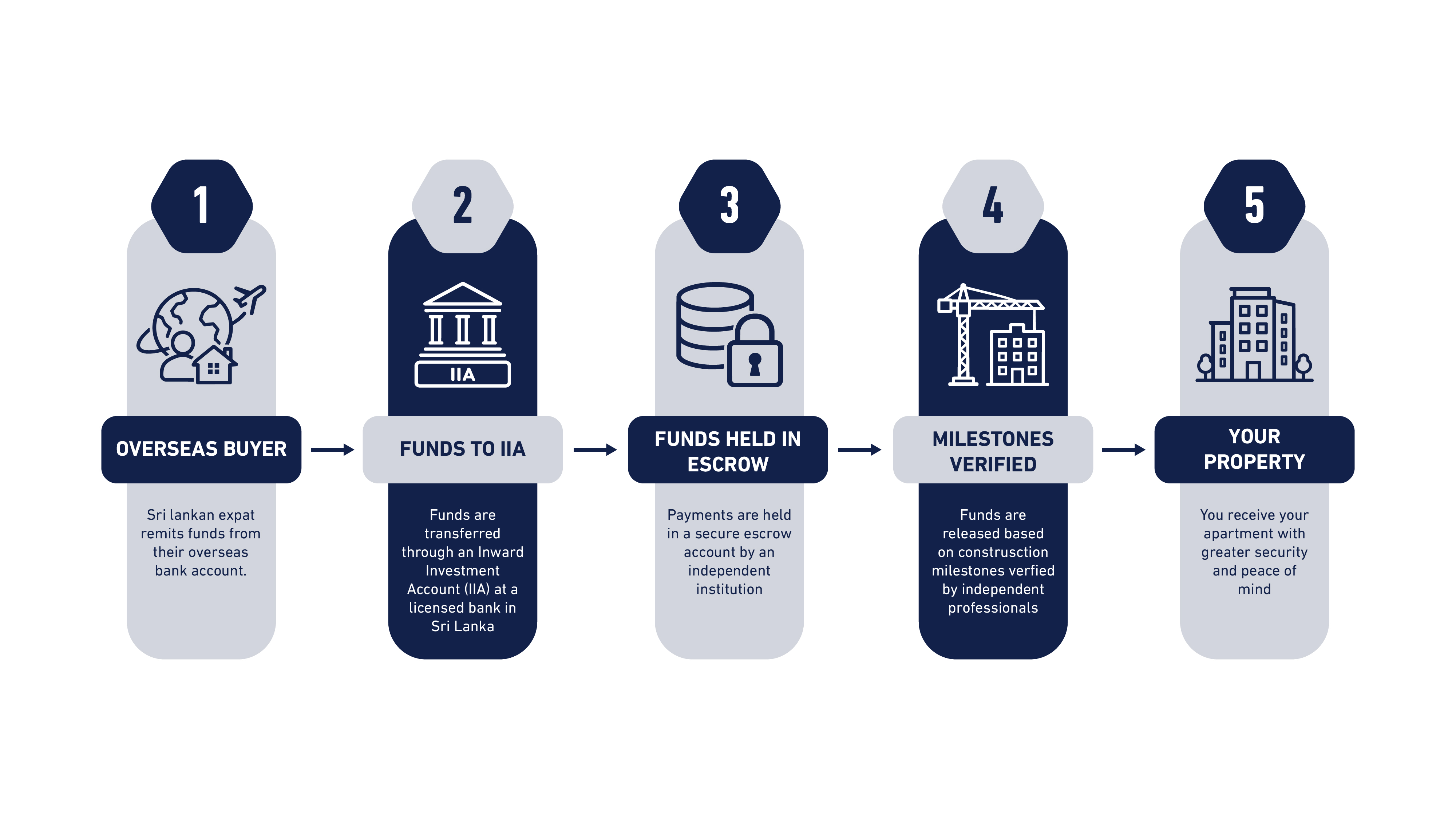
structured payment milestones and escrow arrangements. Buyers do not pay the
entire purchase price at once, but on construction progress stages verified by
independent project engineers or architects.
Are There Escrow Accounts for Foreign Purchasers?
Yes, increasing number of overseas property buyers in the
up-market segment of Sri Lanka’s real estate market are using escrow accounts.
An escrow account is a secure third-party financial arrangement whereby the
funds for the purchase are held by a neutral party (usually a commercial bank
or legal escrow agent) and released to the developer only when pre-defined
construction milestones are certified and met.
Escrow provides obvious protection for the remote buyer:
Fund Safeguarding - Your money is not pooled into general developer
operations but is set aside for the development of your project.
Milestone Verification - Payments are released in tranches only after
independent structural engineers verify completion of specific build stages
(e.g. foundation completion, structural framing or interior fitting).
Risk Mitigation - Escrow agreement clearly defines the terms of the
protection of funds or refunds if the developer does not meet contractual
obligations.
Remote buying of John Keells apartments through IIA and escrow gives investors
the benefit of engaging with top-tier corporate developers who function under
transparent corporate governance standards, structured legal contracts, and
established banking partnerships.
How to avoid property frauds and check developers from abroad?
When you invest in real estate remotely, you need to do your homework to protect your capital. Foreign buyers should exercise discipline in their approach to risk management before signing deals or paying deposits to hold.
How to Verify a Developer Remotely
To verify a developer + property project from another country please follow the due diligence steps below:
1. Check Developer Reputation: Research the developer's
background, financial position and history of project completion. The existing
conglomerates with diversified business models are more accountable than new
unproven single-project entities.
2. Obtain statutory approvals: The project should have obtained all
required legal approvals from the key authorities such as the Urban Development
Authority (UDA), the local Municipal Council, the Central Environmental
Authority (CEA) and the Condominium Management Authority (CMA).
3. Verify Clear Title: Have an independent Sri Lankan attorney-at-law
with expertise in conveyancing conduct a detailed title search at the relevant
Land Registry for a period of at least 30 years.
4. Independent Construction Monitoring: Reputable developers provide
international clients with ongoing construction updates, independent
engineering audits, and access to a digital portal for remote progress
tracking.
What documents do foreign buyers need?
To complete a property transaction remotely, there are certain documents you need to provide to comply with the anti-money laundering (AML) rules, tax rules and the conveyancing standards.
| Document Category | Key Required Documents | Purpose |
| Identity & Residency | Valid Passport copy, proof of overseas address, foreign visa or PR card |
To identify you and to comply with the rules when opening the IIA. |
| Banking & Finance | IIA Account details, Bank reference letters, Source of Funds documentation |
Regulatory compliance on foreign currency inflows. |
| Legal & Representation | Power of Attorney (POA) certified by the Sri Lankan Embassy or High Commission |
Lets you appoint a trusted local legal representative to sign deeds on your behalf. Contractual Documents Reservation agreement, sale & purchase agreement (SPA) Details terms, milestone schedules and developer commitments. |
| Tax Compliance | Taxpayer Identification Number (TIN) from the Inland Revenue Department |
To be used for property registration and tax compliance. |
How to Safely Invest in Real
Estate in Sri Lanka
Here’s a step-by-step structured roadmap to ensure a smooth and safe
remote property purchase:
1. Select an Established Developer: Select an established developer such
as John Keells Properties which has a reputation of institutional reliability,
legal compliance and quality execution.
2. Engage Independent Legal Counsel: Retain a competent Sri Lankan
lawyer to review all contracts, verify titles and oversee property
registration.
3. Open an Inward Investment Account (IIA): Before remitting any funds
for the purchase, you will be required to open an IIA with a commercial bank in
Sri Lanka.
4. Review and Sign Sales & Purchase Agreement (SPA): Make sure the
SPA clearly details milestone-based payment schedules, delivery dates and
escrow terms if applicable.
5. Make payments via authorized banking channels: Transfer the foreign
currency from your foreign bank to your IIA, which then pays the developer or
escrow account as certified milestones are met.
6. Deed of Transfer and Title Registration On project completion and
final payment, your lawyer will prepare the Deed of Transfer to register your
freehold or leasehold title at the Land Registry.
How to Safeguard Your Real Estate Investment from Abroad
Purchasing property as an expatriate in Sri Lanka doesn’t have to be a
complicated or ambiguous process. Through an Inward Investment Account (IIA)
you can build a strong and safe investment portfolio in Sri Lanka from anywhere
in the world, with trusted developers and insisting on payments on a milestone
basis or in an escrow account.
When making your purchase, place greater value on legal clarity and established
institutional governance than on unverified promises. Partnering with
established corporate leaders like John Keells Properties gives you the
institutional transparency, legal oversight and hassle-free remote buyer
support you need to make your real estate journey safe and rewarding.


